Running—or waiting?
Explore equipment running and idle histories across your production floor. Review whether gaps relate to loading, handling, or other work rather than treating all idle time as waste.

A machine stops. A coil changes. The next part waits. Connect camera observations and available machine data to understand the gaps—without another manual time study.
Discuss your shop-floor workflowManual logs miss changeovers. Footage takes time to review. A cycle counter tells only part of the story. Give your team a way to connect production events with the evidence needed to investigate them.
Explore equipment running and idle histories across your production floor. Review whether gaps relate to loading, handling, or other work rather than treating all idle time as waste.
Scope capture of coil loading or die and shoe replacement, with agreed start and end points. Compare similar changeovers and return to the footage when one takes longer.
Look at part counts, machine cycle durations, and the gaps between successive parts separately. A shorter machine cycle does not, by itself, establish better production flow.
These applications require site-specific setup and validation. Cameras must be able to see the relevant actions; machine signals can add context where accessible.
The useful output is not another screen to watch. It is a review of what happened, which patterns deserve attention, and where to look next.
Start with a question such as: “Which coil changes took longer than comparable changes, and what does the footage show?”
Patterns help your team investigate. They do not establish the cause of a delay or automatically require an alert or task.
BizStack brings connected data together around your equipment and operation. Scope camera observations alongside available machine signals and production context, so an event has more meaning than a timestamp alone.
Explore the BizStack platform →Connections and event capture depend on available interfaces, permissions, and deployment requirements. This is an analysis workflow, not autonomous machine control.
A focused evaluation begins with the question your team needs answered—not a promise to monitor every process on the floor.
Define cycle boundaries, expected handling time, and each changeover type. Choose the work periods and comparable parts before interpreting differences.
Review camera angles, lighting, occlusions, and recording access. Confirm which machine signals exist and whether they can be connected.
Compare detected events with reviewed observations. Agree on detection reliability and what would make the resulting history and report useful to your team.
If crew counts or process comparisons are in scope, prefer job-, station-, or crew-level measures. Confirm permissions, privacy, and applicable labor requirements before collecting people-related data. Counts alone do not measure individual productivity.
Our parking demonstration shows occupancy history and an AI-generated report reviewing a heatmap image. See the source material, findings, and checks needed before acting.
This demonstrates the observation-and-review approach—not factory cycle-time measurement or changeover detection. Integrated recurring BizStack Agent reporting remains planned until demonstrated.
Explore the MODE parking demonstration →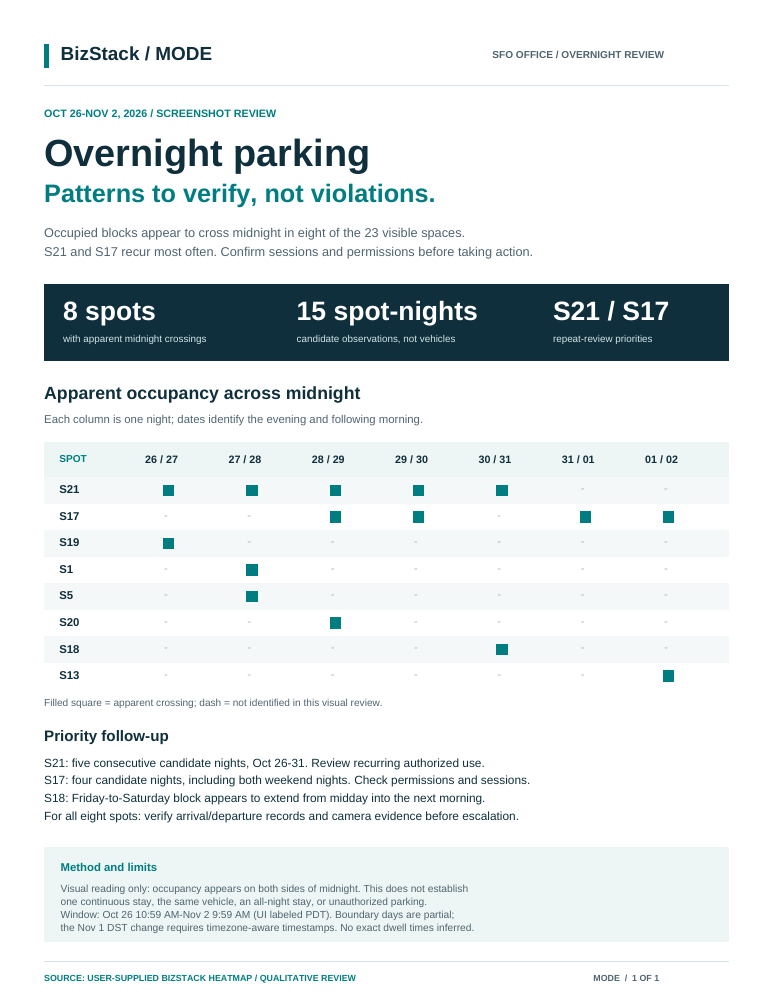
Tell us which machine or changeover matters, how you measure it today, and what a useful review would show. We’ll discuss the data and a practical first evaluation.